AGROMEDICINE CENTER
Profile
Agromedicine
Agromedicine at the Faculty of Medicine, University of Jember (FK UNEJ) represents a comprehensive and integrated healthcare approach that encompasses promotive, preventive, curative, and rehabilitative aspects within the agricultural context. This approach not only focuses on the diagnosis and treatment of diseases related to agricultural activities but also emphasizes disease prevention and the overall improvement of health among agricultural communities in a sustainable manner. Agromedicine views health as the result of complex interactions between humans, the environment, and agricultural activities, thus requiring a multidisciplinary approach involving biology, physics, chemistry, as well as social, economic, and cultural aspects that influence health behavior.
The scope of Agromedicine at FK UNEJ covers various strategic sectors, including agriculture, plantations, livestock, forestry, and fisheries. Each sector presents its own potential health risks, ranging from chemical exposure and occupational hazards to lifestyle patterns within agrarian communities. Therefore, FK UNEJ has developed Agromedicine as a flagship field that bridges the gap between medical science and agriculture, aiming to improve both the quality of agricultural products and the welfare and health of those involved. This approach also contributes to building a responsive healthcare system capable of addressing global challenges such as climate change, food security, and emerging diseases related to agricultural environments.
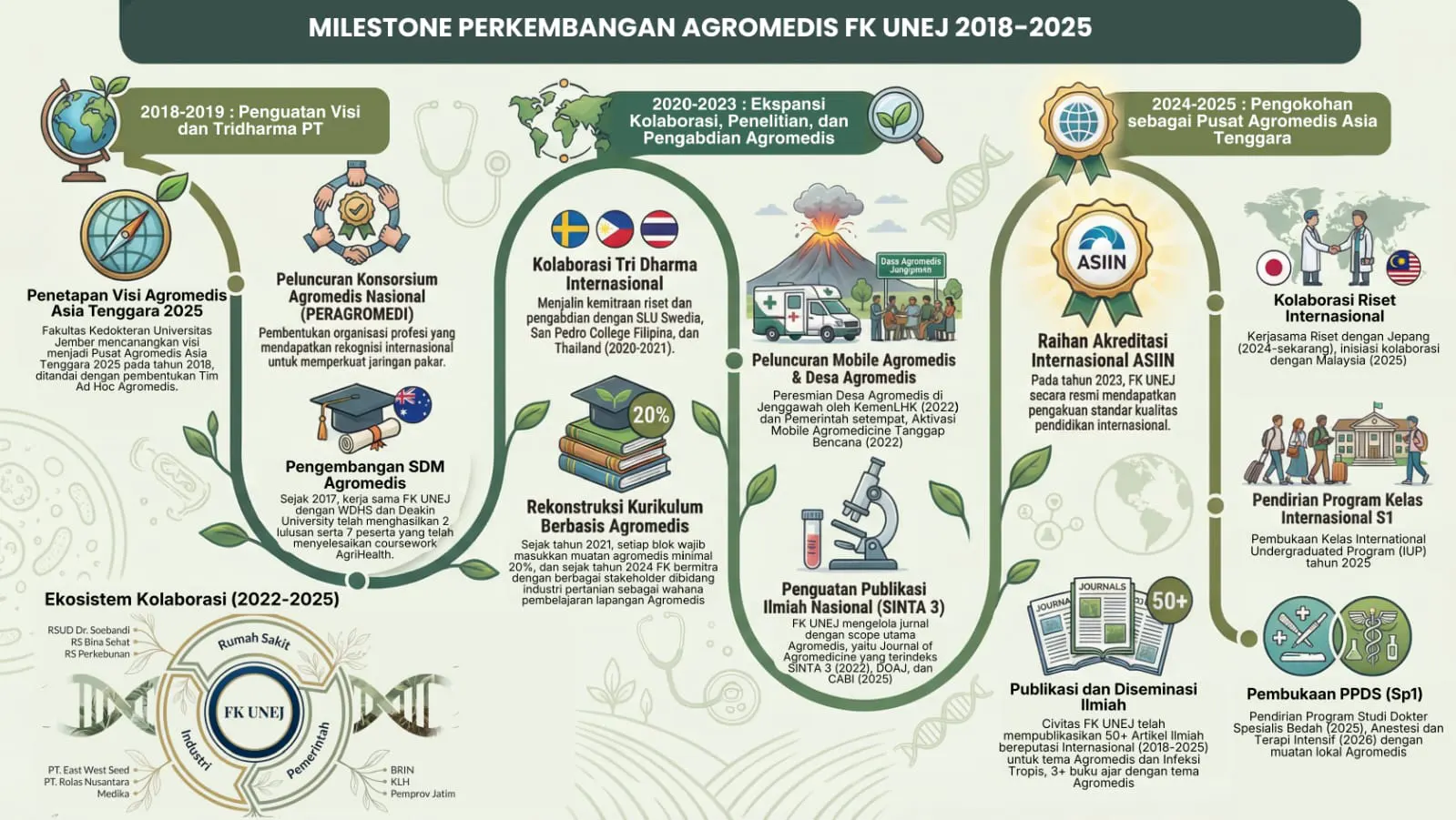
The development of Agromedicine at FK UNEJ began strategically in the 2018–2019 period through the strengthening of its vision and the implementation of the university’s tridharma. During this time, FK UNEJ established its vision to become a center of Agromedicine in Southeast Asia by 2025. The initial step was marked by the formation of an ad hoc Agromedicine team tasked with formulating the direction of scientific development and its implementation. In the same period, the National Agromedicine Consortium (Peragromedi) was launched as a platform for collaboration among experts and institutions, which also received international recognition to strengthen academic networks. To enhance human resource capacity, FK UNEJ established partnerships with Western District Health Service (WDHS) and Deakin University, Australia, resulting in graduates and several participants who have completed coursework in agrihealth.
In the 2020–2023 period, FK UNEJ significantly expanded collaboration, research, and community service initiatives in Agromedicine. International partnerships were strengthened with institutions such as the Swedish University of Agricultural Sciences (SLU), San Pedro College in the Philippines, and partners in Thailand. Since 2021, FK UNEJ has reconstructed its curriculum to be Agromedicine-based by integrating at least 20% Agromedicine content into each learning block. This effort has been supported by partnerships with stakeholders in the agricultural industry and the development of field-based Agromedicine learning platforms. In 2022, FK UNEJ launched the Mobile Agromedicine initiative, focusing on disaster response and community-based healthcare services, as well as establishing an Agromedicine Village in Jenggawah, officially inaugurated by the Ministry of Environment and Forestry. In 2023, FK UNEJ achieved international recognition through the ASIIN accreditation, further strengthening its global academic standing.
In the 2024–2025 period, FK UNEJ continues to solidify its role as a leading Agromedicine center in Southeast Asia through various strategic initiatives. These include strengthening international research collaborations with countries such as Japan and initiating new partnerships with Malaysia. Additionally, FK UNEJ established an International Undergraduate Program (IUP) in 2025 as part of its internationalization efforts. The faculty also continues to expand postgraduate medical education by opening specialist programs (PPDS), including Surgery, Anesthesiology and Intensive Therapy, and Internal Medicine, all of which incorporate Agromedicine-based local content into their curricula.
Overall, Agromedicine at FK UNEJ serves not only as a scientific identity but also as a concrete manifestation of the institution’s commitment to addressing health issues related to agriculture. Through the integration of education, research, and community service, FK UNEJ aims to produce graduates who are competent, adaptive, and globally minded, while making meaningful contributions to improving public health and advancing the agricultural sector both nationally and internationally.