

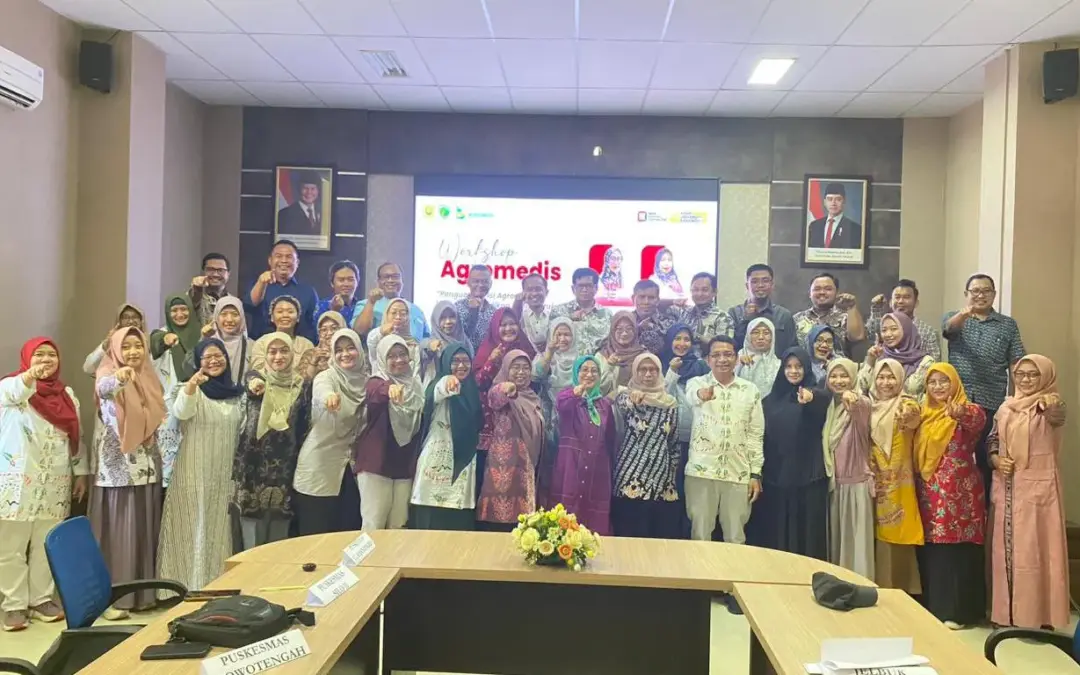
Agromedicine – Through its Agromedicine Concentration, the Faculty of Medicine, University of Jember (FK UNEJ), successfully organized an Agromedicine Workshop held in the FK UNEJ Accreditation Room. This activity was part of FK UNEJ’s commitment to strengthening collaboration between medical education institutions and primary healthcare services throughout Jember Regency.
The workshop invited heads of community health centers (Puskesmas) from various regions across Jember Regency. Their participation reflected strong support for the development of agromedicine-based healthcare services, which have become one of FK UNEJ’s areas of excellence.
The participants included the heads of Puskesmas Cakru, Karangduren, Curahnongko, Patrang, Pakusari, Sumbersari, Sabrang, Panti, Balung, Ambulu, Kencong, Sukorambi, Rambipuji, Bangsalsari, Kaliwates, Rowotengah, Sumberbaru, Silo II, Umbulsari, Kalisat, Silo I, Andongsari, Nogosari, Tanggul, Jelbuk, and Sukowono.
The workshop discussed various health issues in primary healthcare services related to agromedicine. The main focus of the discussion was on health problems caused by agricultural work environments, pesticide exposure, and diseases commonly found in agrarian communities.
The workshop consisted of two main sessions designed to provide both theoretical understanding and interactive discussion opportunities for all participants. In the first session, participants received presentations on agromedicine and diseases associated with agricultural activities and agrarian work environments.
The session was delivered by FK UNEJ agromedicine expert, Dr.rer.biol.hum. dr. Erma Sulistyaningsih, M.Si., GCertAgHealthMed. In her presentation, she emphasized the importance of applying an agromedicine approach in primary healthcare services, especially in areas where most residents work in the agricultural sector.
In addition, participants were introduced to various public health challenges related to agricultural chemical exposure, occupational safety for farmers, and promotive as well as preventive healthcare strategies that can be implemented at community health centers.
The second session continued with a Focus Group Discussion (FGD), where participants were divided into two discussion groups. During the FGD, participants shared experiences, challenges, and strategies related to agromedicine cases within their respective healthcare service areas.
The discussions were highly interactive, as each participant described real conditions and challenges faced in the field. Through this activity, FK UNEJ also gathered valuable input that can support the future development of more applicable and community-oriented agromedicine education and healthcare services.
At the end of the workshop, all discussion results were summarized as a shared commitment to strengthening collaboration between FK UNEJ and community health centers throughout Jember Regency. In the future, all community health centers in Jember Regency are expected to serve as professional training sites for FK UNEJ students, supporting both the improvement of medical education quality and agromedicine-based public healthcare services.
Author: AKR